
How we traded scattered spreadsheets and "who owns this?" chaos for a calm, predictable delivery rhythm across every squad.

Let us take you back to the early days of YOUGotaGift.
It was a simpler time. A quieter time.
There were two or three heroic developers. These noble beings didn't just wear multiple hats. They wore the whole wardrobe.
They would code, test and release everything by themselves, possibly while restarting the WiFi router, debugging the printer, and explaining for the fifth time that "Have you tried turning it off and on again?" is a valid solution. They even approved their own leaves, I heard.
In the beginning, things were chill. There were, like, 5 tasks. Everyone remembered everything. Life was good.
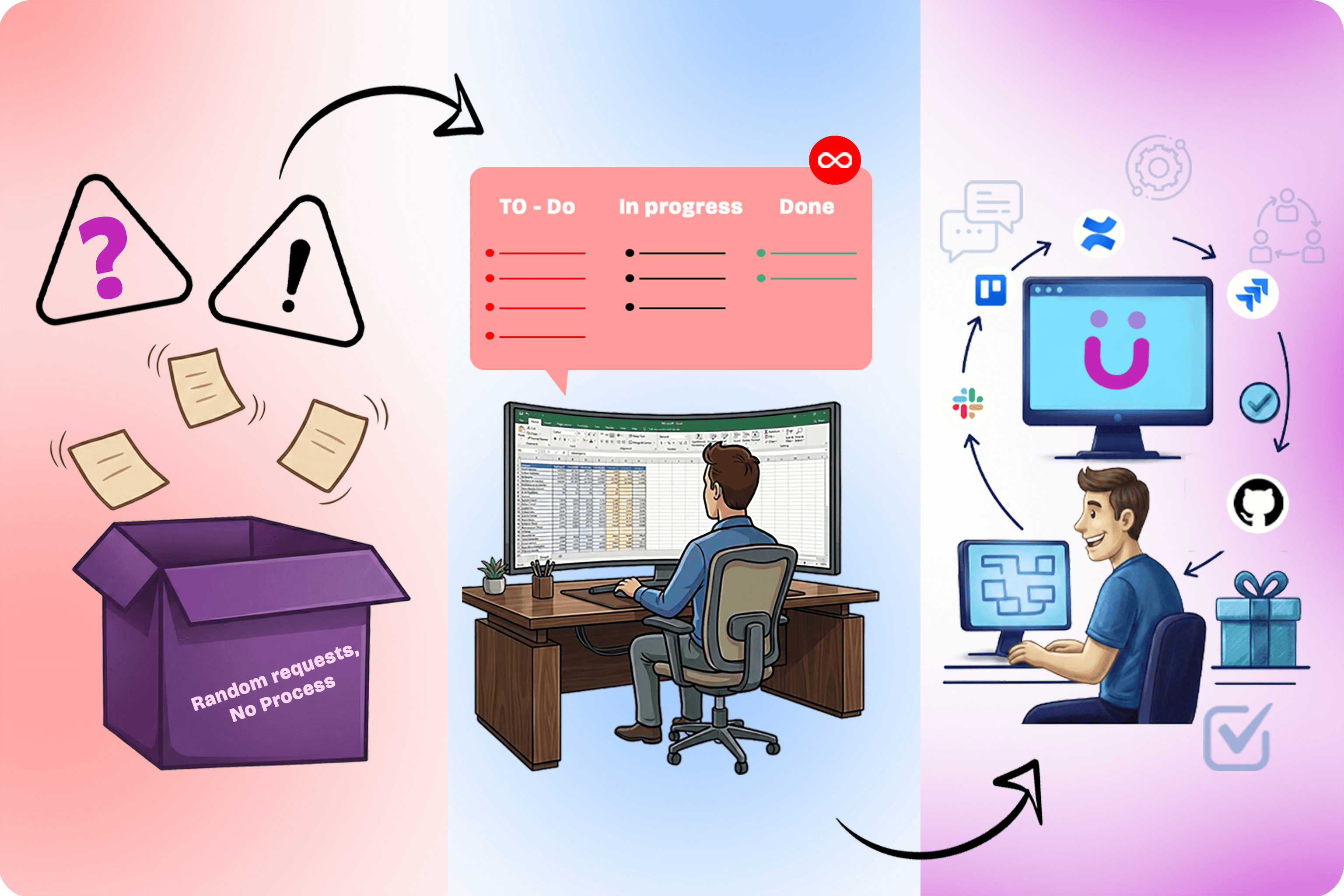
But then, the company did something wild: it started to grow. Suddenly there were 20 tasks in the pipeline, 10 things in progress and 3 stakeholders asking, "Where is my feature?" and that's when the chaos hit — beautiful, legendary chaos. But Chaos, nonetheless.
As the task list grew longer than our office coffee bill, things started to fall through the cracks. The developers were drowning in code and couldn't keep track of everything. The tech lead, who was also buried under development work, tried to juggle it all, but juggling flaming swords while blindfolded would have been easier.
Stakeholders started noticing that their precious requests were vanishing into the void (aka forgotten Slack messages) and developers began to suffer from chronic deadline amnesia.
Our CTO looked at this glorious mess and asked the all-important question:
"If we can't track 20 tasks now, how will we survive with 50 or more developers in the future?"
So under his leadership, the company started looking for "The Way". The Sacred Path. The thing other companies seem to do but we weren't doing. And that's when someone whispered the holy word: Project Management.
We started our deep dive into this mythical land called Agile. It said cool things like "Sprint" and "Scrum" and "iterations" and "burndown charts" (which we initially thought were something to do with Office snacks). We had no idea what any of it meant.
Turns out we weren't alone in our struggles. So, we did what all great minds do: we Googled, we YouTubed and we stalked people from other companies and asked them — "How are you not panicking every day? Spill the tea."
Ah, JIRA. "Jira is simple, Jira is powerful, Jira is safe." — Said no one ever, while drowning in 38 open tickets, 3 missing subtasks, and a rogue epic that just reappeared out of nowhere.
Yes, Jira is simple, also confusing enough to make us question our life choices. So naturally we started small. We had just bought a shiny new JIRA subscription and were very excited about it — like adults buying a treadmill and immediately feeling healthier. The problem? We absolutely had no idea how to use it efficiently. Or correctly. Or confidently. JIRA felt less like a project management tool and more like a Jigsaw puzzle designed by someone who enjoys adding extra pieces just to watch you suffer.
We didn't start running sprints immediately. Oh no. That would have required knowledge. Our grand adventure began with creating stories and updating work items using JIRA's default statuses. Click. Drag. Feel productive. Repeat.
We read about estimates too. It looked way too easy. Finally, our chance to confidently guess and look smart doing it. We guessed timelines like weather forecasts — boldly, publicly and wrong about 50% of the time. Some tasks took longer. Some took much longer. A few seemed to age gracefully while still "almost done".
We thought adding tasks and estimates would solve everything. Spoiler: it did not. So, like any responsible team in mild panic, we Googled again. We watched videos again (Eternally grateful to Google, random bloggers and that one YouTube guy with 12 views who somehow saved us). And then, like a plot twist in a sitcom, we stumbled upon something called a Sprint. That's when we dug deeper, learned the ropes, and slowly, very slowly — started implementing sprints in our own quirky, but ever-improving way.
At YOUGotaGift, we don't just send presents — we also receive problems. Daily. With Love.
As our features grew, so did the plot twists. We planned Sprints in advance (big step) but Sprint plans were getting ruined by surprise "urgent" tasks like uninvited guests at a gift exchange. So we assigned a dedicated engineer just to handle all those "Hey, can you just do this small thing?" mid-sprint requests.
Our estimates? Gloriously wrong. Turns out you can't squeeze 160 hours of work into a 40-hour week, no matter how optimistic the JIRA labels are. So we brought in a Capacity Tracker. PRDs that read like riddles from a confused wizard got their own JIRA statuses. And bit by bit, slowly, we started trapping these problems. It was a thing of beauty.
At this point, our developers were spending more time figuring out JIRA than writing code. It was killing productivity. So we birthed a new legendary team: Project Management Administration (PMA) — our JIRA Wizards, Slack ninjas, and general saviors of sanity — "The Gift Wrappers" of all our messy processes. They didn't come with a superhero cape, but with a Trello board and a Confluence doc template.
The PMA heroes took over JIRA setup, made tools talk to each other, and generally made the developers stop weeping over workflows. Some of their behind-the-scenes magic includes:
PMA introduced logic into our JIRA workflows with our CTO's supervision. No more floating tickets or existential status labels like "Review-ish." Every movement now makes sense — even to people who read nothing but the Slack thread.
Everything lives on Confluence now — because if it's not written down, it doesn't exist. Thanks to PMA, this documentation paradise now includes: Product admin guides, Feature walkthroughs, Operational Playbooks, Jira workflows, Architecture Diagrams, and yes, that one doc we pretend to update every quarter but mostly don't.
And yes, it's all searchable. We have recently published all these guides on our portals with AI search — so finding the right document is now faster than a developer blaming the server for their code not working.
All code is stored on GitHub, where it's beautifully versioned, secure, and traceable from commit to production. PMA doesn't write the code, but they make sure no one gets lost between the branches. Literally.
Slack isn't just a chat app — it's our central nervous system. Project initiation? In threads. Stakeholder questions? Tagged and tracked. PMA doesn't answer your Slack questions. They just make sure the process for how to ask, answer, and escalate exists. Which, let's be honest, is even better.
Thanks to them, our tools — Slack, Confluence, JIRA, GitHub, Trello — don't just sit around looking pretty. They actually work. Together. In harmony. Well, most of the time.
Project Managers entered the YOUGotaGift scene like gift cards during the holidays — unexpected, shiny and exactly what we needed. Trained in the ancient arts of timelines, follow-ups, and "Why is this still in To Do?", they were here to enforce the processes we spent years evolving.
Their job?
The PMO team isn't about the daily ticket drama. They are the ones setting the stage, building the rules, and making sure no one runs off with the production server. They set standards, support project teams, align every project with YOUGotaGift's big picture goals, handle strategic planning, resource balancing and governance (a fancy word for "please follow the process!"), manage risks, issues and occasional emotional breakdowns (usually over timelines), and oversee formal project closure — because "it's done" means more than pushing to prod.
The PMO team and the PMA team worked together in perfect harmony, assembling processes like IKEA furniture — with enough instructions that even developers could follow it. The PMO team listened patiently to every product tweak, every tech blocker, and every stakeholder's "urgent-but-not-urgent" escalation. Then they analysed it all and translated it into something the PMA team could build into real processes. One workflow at a time, things got smoother, smarter, and finally — it made sense.
Today we are a whole new beast — a beautiful, well-oiled, slightly caffeinated machine. So how do we run a larger engineering team now? With a mix of:
Now, there are no more accidental deployments, no more floating PRDs, and definitely no more "where's the Figma link?" Best of all — our developers can finally develop, and the rest of us can stop asking, "Wait, who is supposed to do this again?"
And behind every successful sprint is a PMO quietly updating the Stakeholder, fixing the blocker, and yelling in their head: "WHY IS THE STATUS OF THIS TASK STILL NOT CHANGED?!"
Well, we now have a knowledge base so powerful, it's like a second brain that answers questions in minutes, gives instant summaries, and remembers a decade's worth of our glorious mistakes. Over the years, our accumulated docs, defined PRDs, and processes have all gained AI superpowers.
And yes, just like that, we have gone from "YOUGotaGift… of chaos" to "YOUGotaGift… of solid Project Management".
And yes, while we still occasionally miss deadlines, at least now we know why. Because it's documented. On JIRA. With a comment thread. And a status. And a sub-task. And a Confluence link to the PRD. And probably a smiling emoji.
Got a team in havoc? Want to go from sticky notes to scalable workflows? We've been there. We survived. And we gift-wrapped the survival guide for you.
Want to know how we did it? Ping us. Pick our brains. Or just tag us in your favourite "Agile gone wrong" meme.